Facebook Instagram Twitter Vimeo Youtube
Sign in
  • Home
  • About
  • Team
  • Buy now!
Sign in
Welcome!Log into your account
Forgot your password?
Privacy Policy
Password recovery
Recover your password
Search
Logo
Sign in
Welcome! Log into your account
Forgot your password? Get help
Privacy Policy
Password recovery
Recover your password
A password will be e-mailed to you.
Thursday, February 26, 2026
Sign in / Join
  • Contact Us
  • Our Team
Facebook
Instagram
Twitter
Vimeo
Youtube
Logo
  • Home
  • News
    • News

      Interview With David Kosmayer – Bookmark by Aviva Zacks

      25 December 2025
      News

      House Democrats Official Online Resume Bank Exposed the PII of Thousands of Government Job Seekers by

      6 December 2025
      News

      House Democrats Official Online Resume Bank Exposed the PII of Thousands of Government Job Seekers by

      29 October 2025
      News

      Cloudflare Thwarts Record-Breaking 22.2 Tbps DDoS Attack by Paige Henley

      3 October 2025
      News

      Ransomware Attack Hits Major European Airports via Collins Aerospace Software by Husain Parvez

      3 October 2025
  • Data Modelling & AI
    • AllBig dataBusiness AnalyticsData ScienceData Structure & AlgorithmDatabasesVector DatabaseDeep LearningEthical HackingGenerative AIMachine Learning
      Big data

      Adding Persistent Memory to Claude Code with the Lightweight memsearch Plugin

      14 February 2026
      Big data

      GLM-5 vs. MiniMax M2.5 vs. Gemini 3 Deep Think: Which Model Fits Your AI Agent Stack?

      14 February 2026
      Big data

      We Extracted OpenClaw’s Memory System and Open-Sourced It (memsearch)

      14 February 2026
      Big data

      OpenClaw (Formerly Clawdbot & Moltbot) Explained: A Complete Guide to the Autonomous AI Agent

      11 February 2026
    • Big data
    • Business Analytics
    • Databases
    • Data Structure & Algorithm
    • Data Science
    • Deep Learning
    • Ethical Hacking
    • Generative AI
    • Machine Learning
    • Security & Testing
  • Mobile
    • AllAndroidIOS
      Android

      I love my Pixel, but I’d trade it for this in a heartbeat

      16 February 2026
      Android

      I stopped fighting Google Sheets after Gemini made formulas feel optional

      15 February 2026
      Android

      We need to talk about this.

      15 February 2026
      Android

      This Galaxy S26 leak highlights a trend that makes me want to skip it

      15 February 2026
    • Android
    • IOS
  • Languages
    • AllAjaxAngularDynamic ProgrammingGolangJavaJavascriptPhpPythonReactVue
      Languages

      Working with Titles and Heading – Python docx Module

      25 June 2025
      Languages

      Creating a Receipt Calculator using Python

      25 June 2025
      Languages

      One Liner for Python if-elif-else Statements

      25 June 2025
      Languages

      Add Years to datetime Object in Python

      25 June 2025
    • Java
    • Python
    • Ajax
    • Php
    • Python
    • Golang
    • Dynamic Programming
    • React
    • Vue
    • Java
    • Javascript
    • NodeJS
    • Angular
  • Guest Blogs
  • Discussion
  • Our Team
HomeData Modelling & AIBig dataRate Limiting Algorithms Explained with Code
Big dataGuest Blogs

Rate Limiting Algorithms Explained with Code

Algomaster
By Algomaster
15 June 2025
0
0
Share
Facebook
Twitter
Pinterest
WhatsApp

    Rate Limiting Algorithms Explained with Code

    #20 Rate Limiting Algorithms

    Ashish Pratap Singh's avatar

    Ashish Pratap Singh
    Jul 17, 2024

    Rate limiting helps protects services from being overwhelmed by too many requests from a single user or client.

    In this article we will dive into 5 of the most common rate limiting algorithms, their pros and cons and learn how to implement them in code.


    If you’re finding this newsletter valuable and want to deepen your learning, consider becoming a paid subscriber.

    As a paid subscriber, you’ll receive an exclusive deep-dive article every week, access to a structured System Design Resource (100+ topics and interview questions), and other premium perks.

    Unlock Full Access


    1. Token Bucket

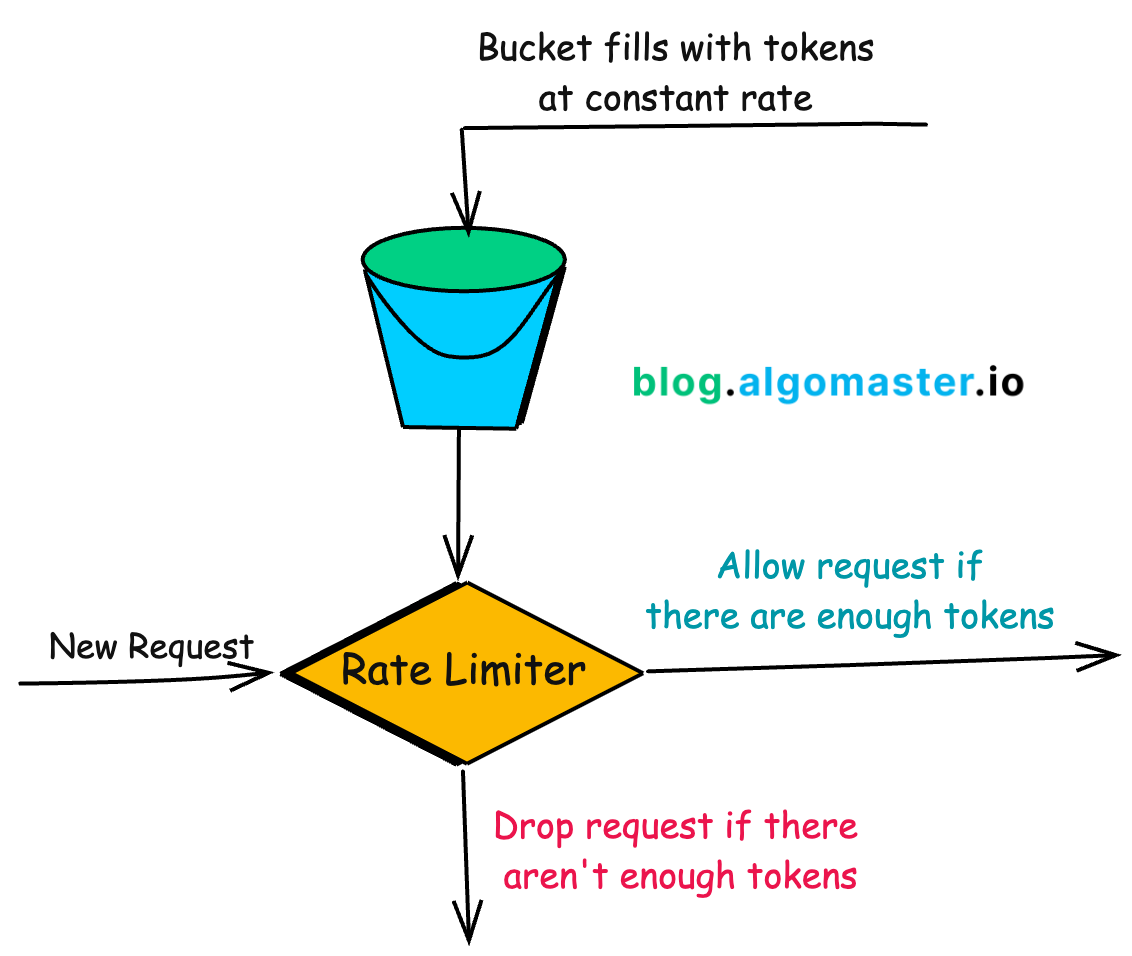
    The Token Bucket algorithm is one of the most popular and widely used rate limiting approaches due to its simplicity and effectiveness.

    How It Works:

    • Imagine a bucket that holds tokens.

    • The bucket has a maximum capacity of tokens.

    • Tokens are added to the bucket at a fixed rate (e.g., 10 tokens per second).

    • When a request arrives, it must obtain a token from the bucket to proceed.

    • If there are enough tokens, the request is allowed and tokens are removed.

    • If there aren’t enough tokens, the request is dropped.
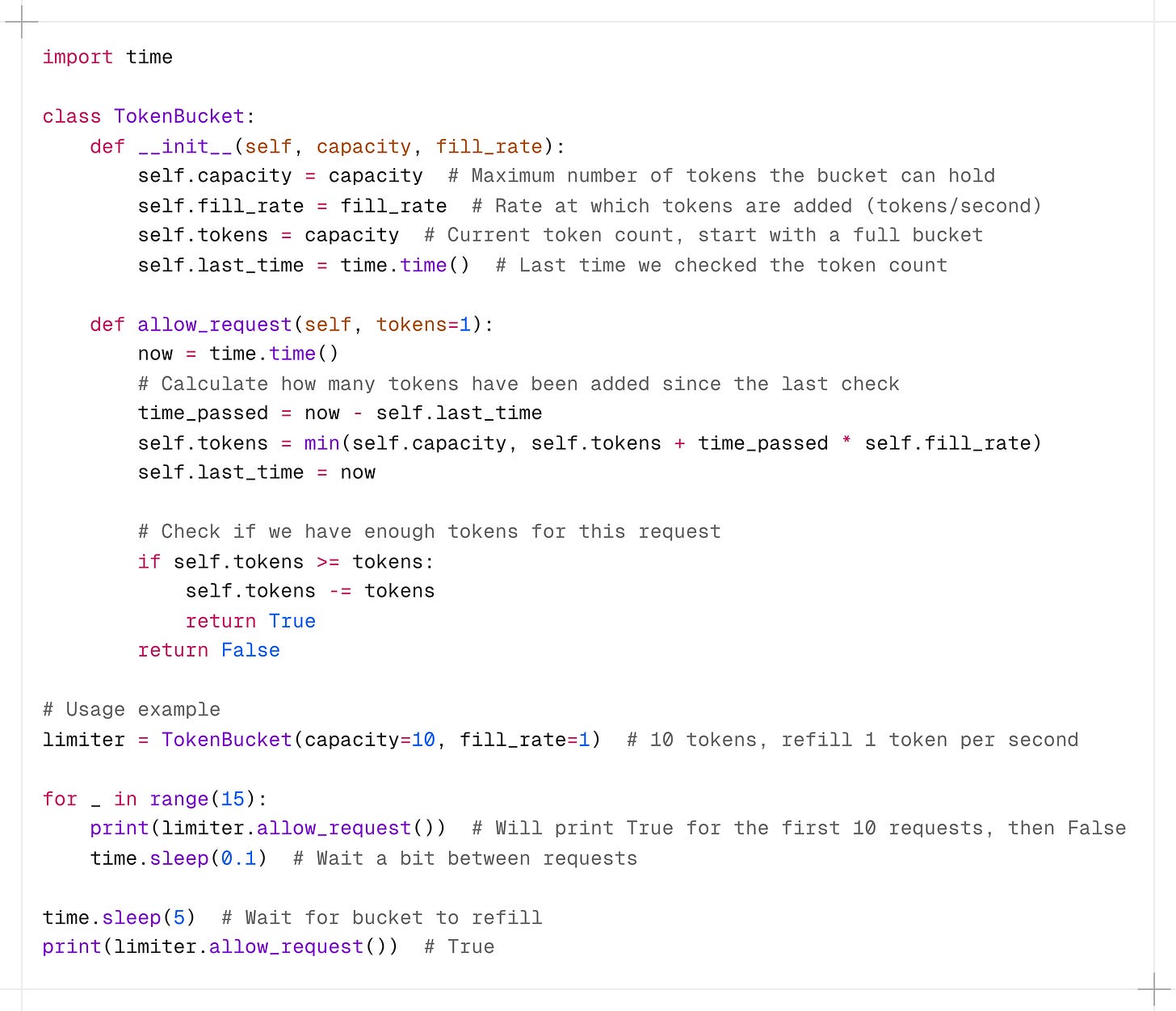
    Code Link: Python, Java

    Pros:

    • Relatively straightforward to implement and understand.

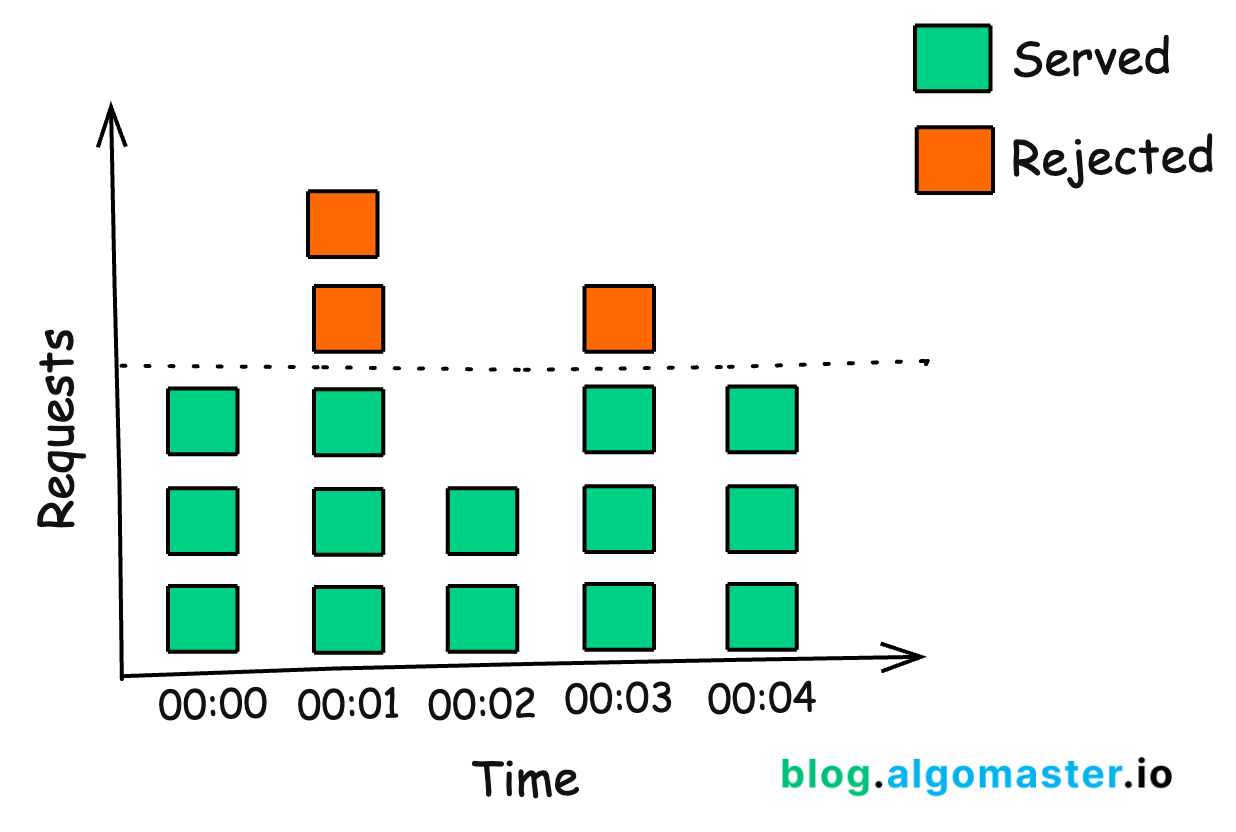
    • Allows bursts of requests up to the bucket’s capacity, accommodating short-term spikes.

    Cons:

    • The memory usage scales with the number of users if implemented per-user.

    • It doesn’t guarantee a perfectly smooth rate of requests.


    2. Leaky Bucket
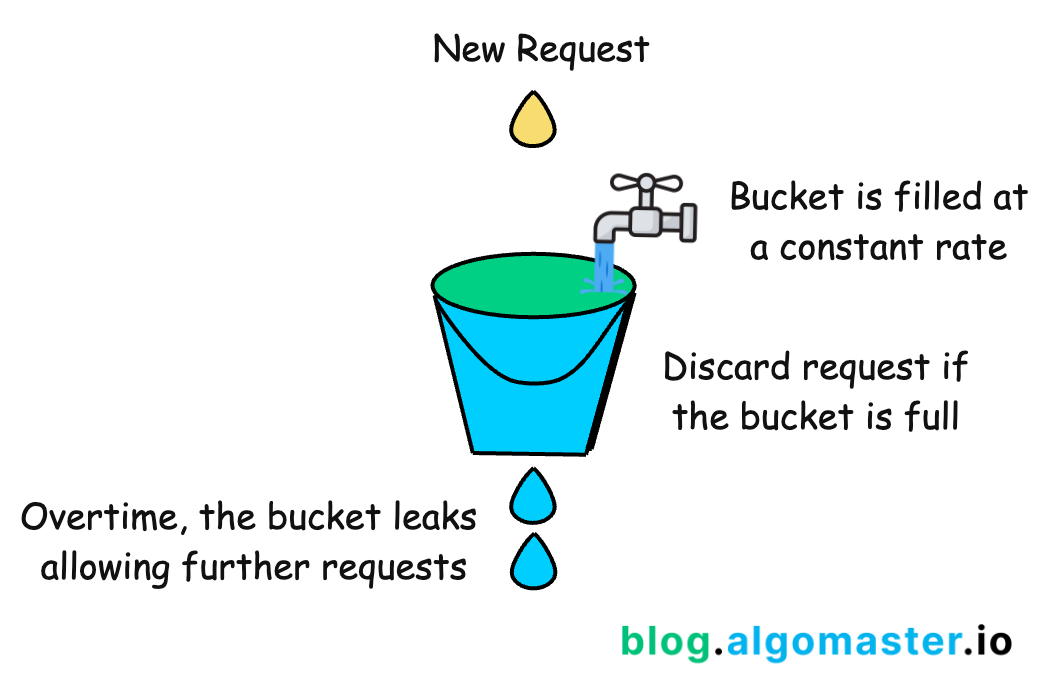
    The Leaky Bucket algorithm is similar to Token Bucket but focuses on smoothing out bursty traffic.

    How it works:

    1. Imagine a bucket with a small hole in the bottom.

    2. Requests enter the bucket from the top.

    3. The bucket processes (“leaks”) requests at a constant rate through the hole.

    4. If the bucket is full, new requests are discarded.
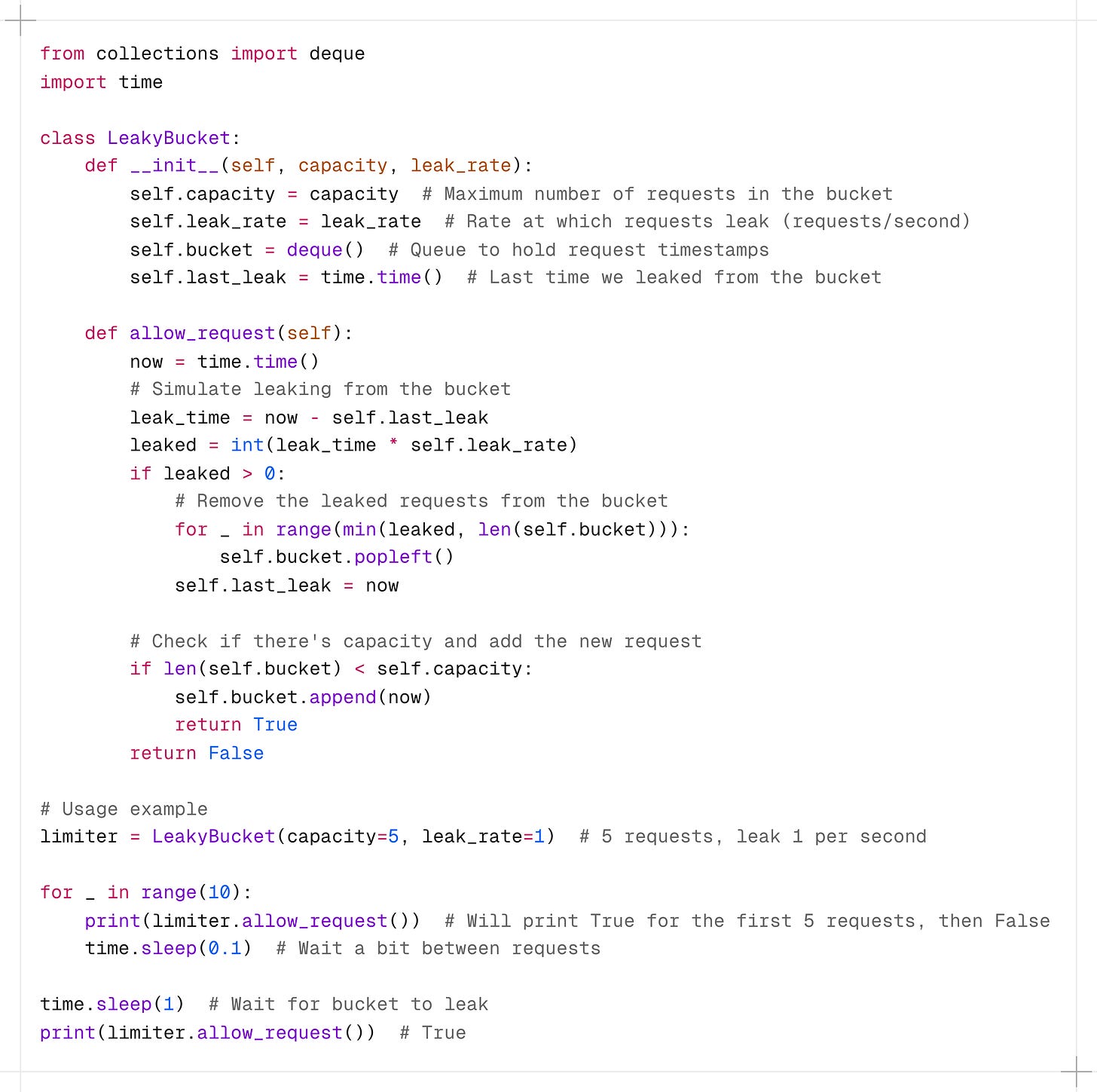
    Code Link: Python, Java

    Pros:

    • Processes requests at a steady rate, preventing sudden bursts from overwhelming the system.

    • Provides a consistent and predictable rate of processing requests.

    Cons:

    • Does not handle sudden bursts of requests well; excess requests are immediately dropped.

    • Slightly more complex to implement compared to Token Bucket.

    Share


    3. Fixed Window Counter

    The Fixed Window Counter algorithm divides time into fixed windows and counts requests in each window.

    How it works:

    1. Time is divided into fixed windows (e.g., 1-minute intervals).

    2. Each window has a counter that starts at zero.

    3. New requests increment the counter for the current window.

    4. If the counter exceeds the limit, requests are denied until the next window.
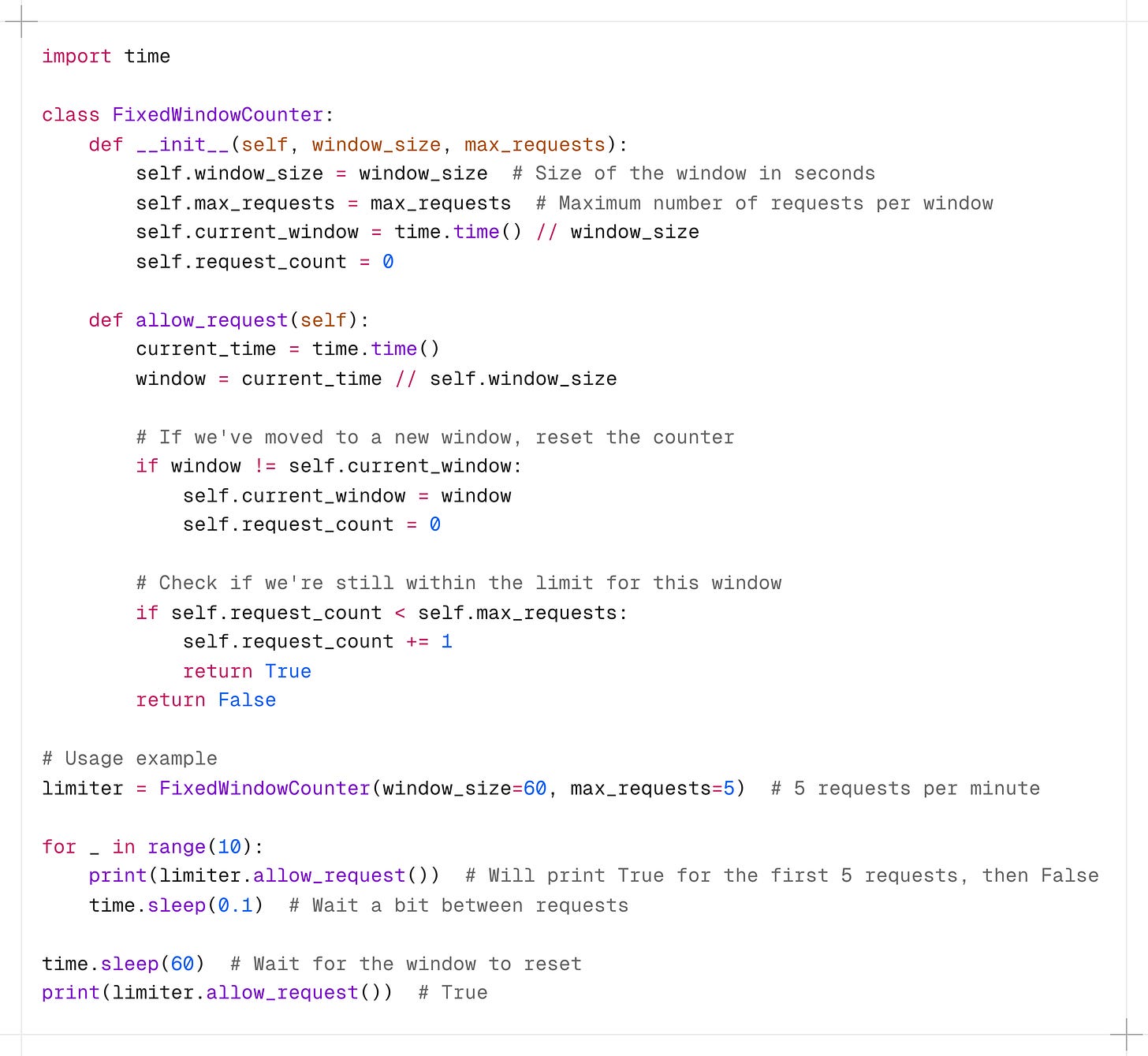
    Code Link: Python, Java

    Pros:

    • Easy to implement and understand.

    • Provides clear and easy-to-understand rate limits for each time window.

    Cons:

    • Does not handle bursts of requests at the boundary of windows well. Can allow twice the rate of requests at the edges of windows.


    4. Sliding Window Log
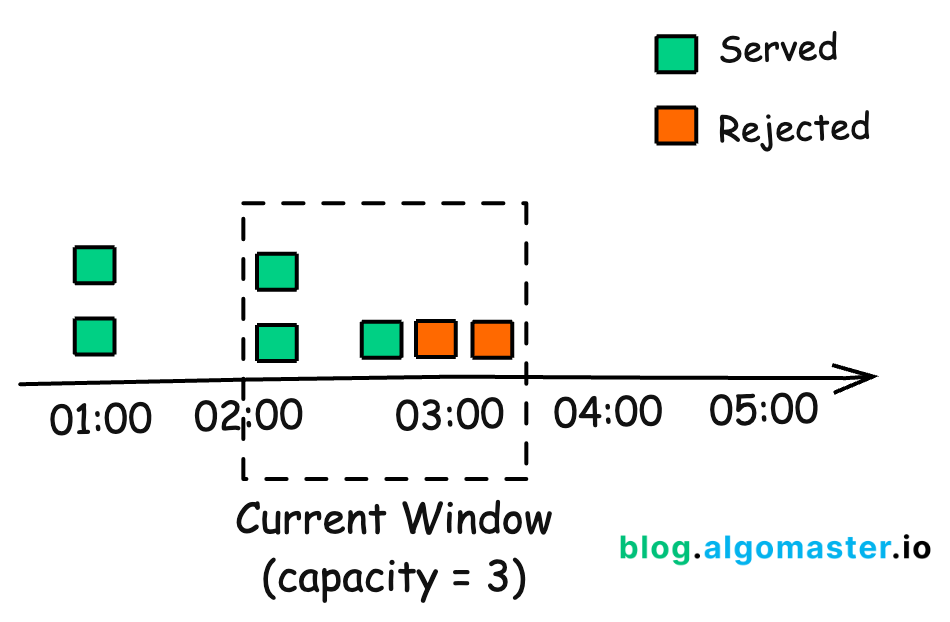
    The Sliding Window Log algorithm keeps a log of timestamps for each request and uses this to determine if a new request should be allowed.

    How it works:

    1. Keep a log of request timestamps.

    2. When a new request comes in, remove all entries older than the window size.

    3. Count the remaining entries.

    4. If the count is less than the limit, allow the request and add its timestamp to the log.

    5. If the count exceeds the limit, request is denied.
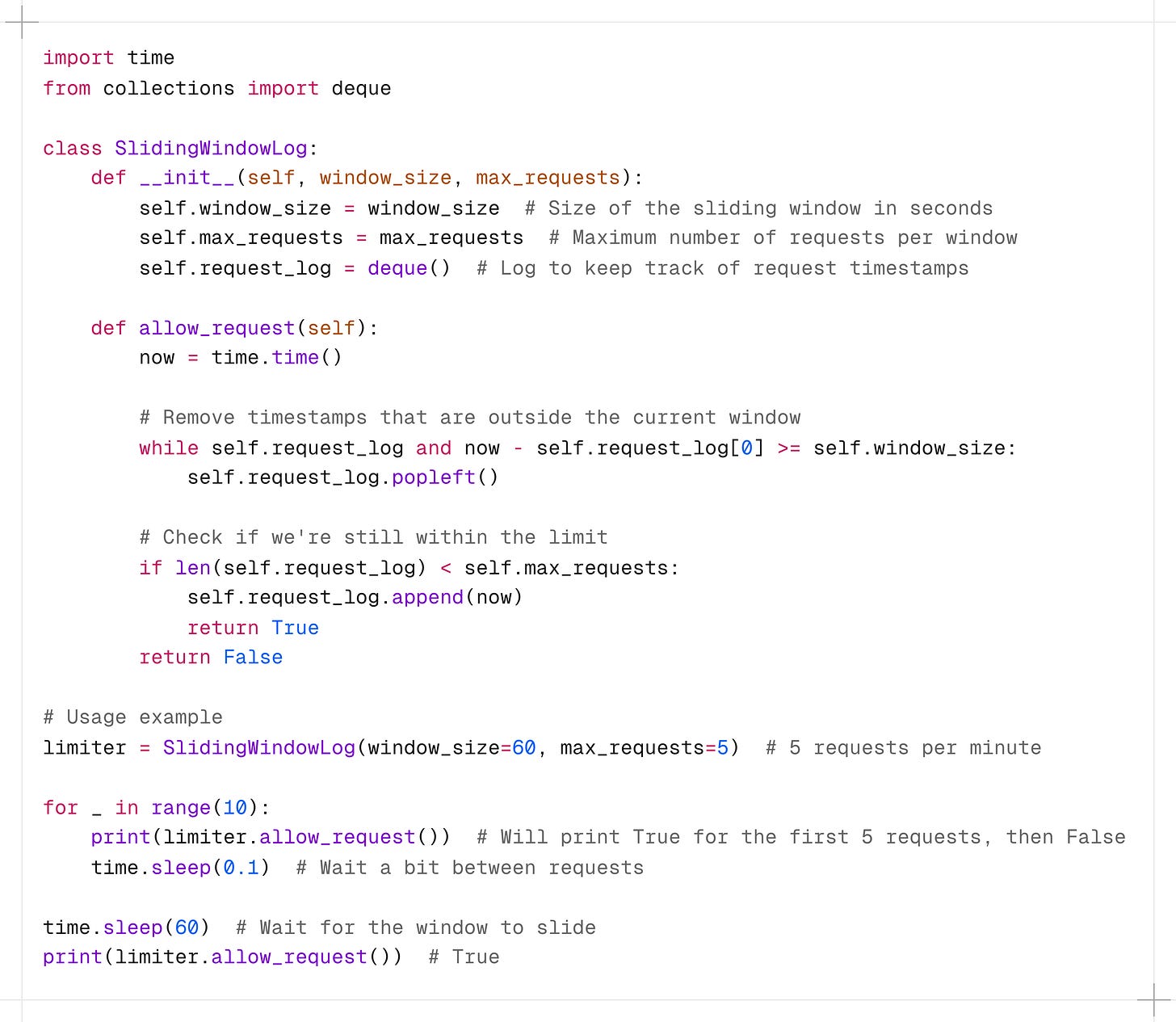
    Code Link: Python, Java

    Pros:

    • Very accurate, no rough edges between windows.

    • Works well for low-volume APIs.

    Cons:

    • Can be memory-intensive for high-volume APIs.

    • Requires storing and searching through timestamps.


    5. Sliding Window Counter
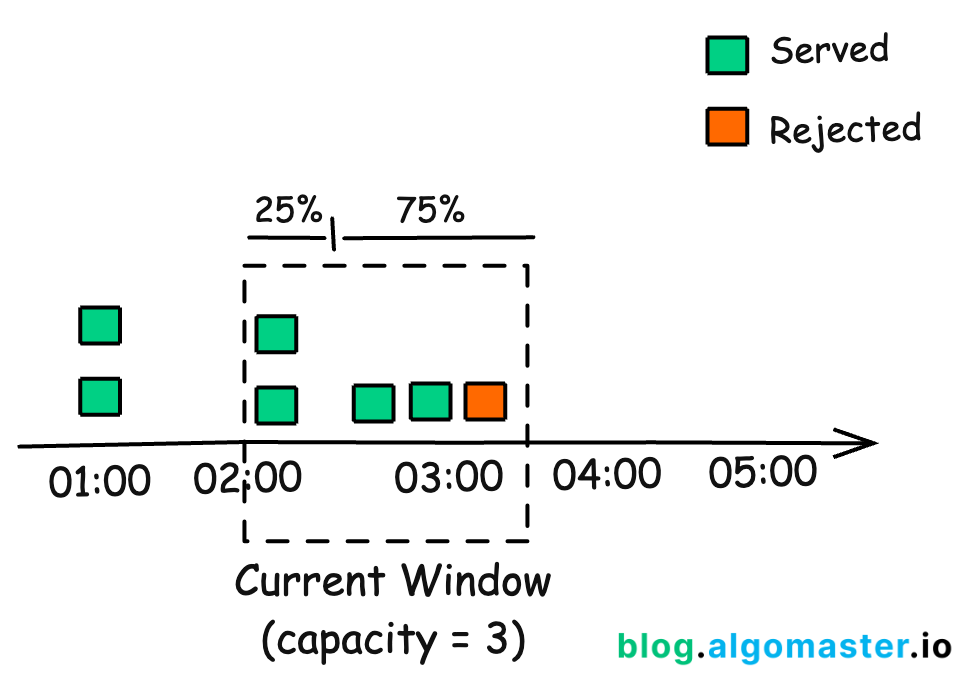
    This algorithm combines the Fixed Window Counter and Sliding Window Log approaches for a more accurate and efficient solution.

    Instead of keeping track of every single request’s timestamp as the sliding log does, it focus on the number of requests from the last window.

    So, if you are in 75% of the current window, 25% of the weight would come from the previous window, and the rest from the current one:

    weight = (100 - 75)% * lastWindowRequests + currentWindowRequests

    Now, when a new request comes, you add one to that weight (weight + 1). If this new total crosses our set limit, we have to reject the request.

    How it works:

    1. Keep track of request count for the current and previous window.

    2. Calculate the weighted sum of requests based on the overlap with the sliding window.

    3. If the weighted sum is less than the limit, allow the request.
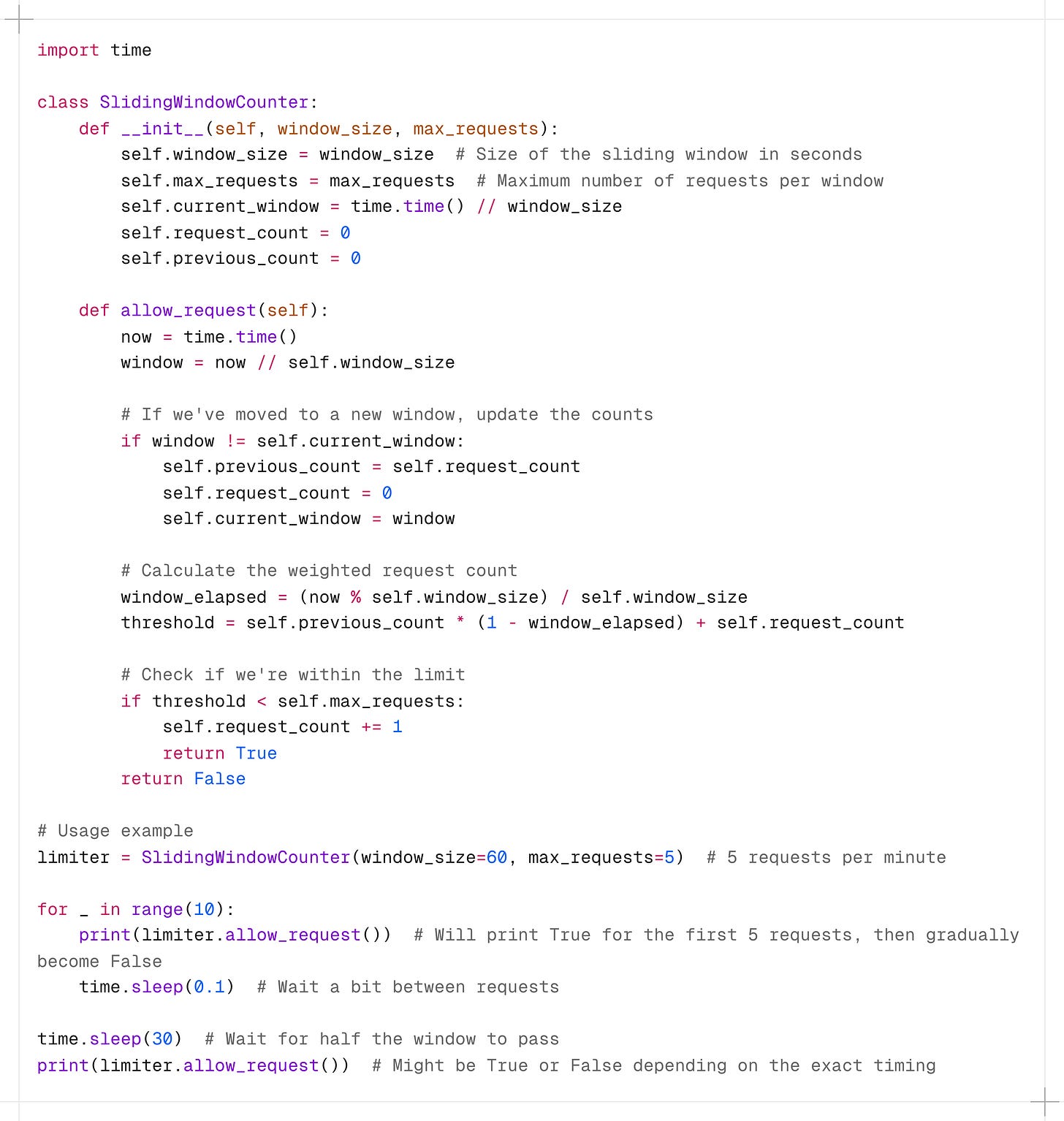
    Code Link: Python, Java

    Pros:

    • More accurate than Fixed Window Counter.

    • More memory-efficient than Sliding Window Log.

    • Smooths out edges between windows.

    Cons:

    • Slightly more complex to implement.

    When implementing rate limiting, consider factors such as the scale of your system, the nature of your traffic patterns, and the granularity of control you need.

    Lastly, always communicate your rate limits clearly to your API users, preferably through response headers, so they can implement appropriate retry and backoff strategies in their clients.


    Thank you for reading!

    If you found it valuable, hit a like ❤️ and consider subscribing for more such content every week.

    If you have any questions or suggestions, leave a comment.

    This post is public so feel free to share it.

    Share


    P.S. If you’re finding this newsletter helpful and want to get even more value, consider becoming a paid subscriber.

    As a paid subscriber, you’ll receive an exclusive deep dive every week, access to a comprehensive system design learning resource , and other premium perks.

    Get full access to AlgoMaster

    There are group discounts, gift options, and referral bonuses available.


    Checkout my Youtube channel for more in-depth content.

    Follow me on LinkedIn, X and Medium to stay updated.

    Checkout my GitHub repositories for free interview preparation resources.

    I hope you have a lovely day!

    See you soon,
    Ashish

    Share
    Facebook
    Twitter
    Pinterest
    WhatsApp
      Previous article
      Design a Scalable Notification Service – System Design Interview
      Next article
      UML Class Diagram Explained with Examples
      Algomaster
      Algomasterhttps://blog.algomaster.io
      RELATED ARTICLES
      Guest Blogs

      5 Best Parental Controls for Teenagers in 2026 by Penka Hristovska

      14 February 2026
      Big data

      Adding Persistent Memory to Claude Code with the Lightweight memsearch Plugin

      14 February 2026
      Big data

      GLM-5 vs. MiniMax M2.5 vs. Gemini 3 Deep Think: Which Model Fits Your AI Agent Stack?

      14 February 2026

      LEAVE A REPLY Cancel reply

      Log in to leave a comment

      Most Popular

      I love my Pixel, but I’d trade it for this in a heartbeat

      16 February 2026

      I stopped fighting Google Sheets after Gemini made formulas feel optional

      15 February 2026

      We need to talk about this.

      15 February 2026

      This Galaxy S26 leak highlights a trend that makes me want to skip it

      15 February 2026
      Load more
      Algomaster
      Algomaster
      202 POSTS0 COMMENTS
      https://blog.algomaster.io
      Calisto Chipfumbu
      Calisto Chipfumbu
      6873 POSTS0 COMMENTS
      http://cchipfumbu@gmail.com
      Dominic
      Dominic
      32506 POSTS0 COMMENTS
      http://wardslaus.com
      Milvus
      Milvus
      131 POSTS0 COMMENTS
      https://milvus.io/
      Nango Kala
      Nango Kala
      6882 POSTS0 COMMENTS
      neverop
      neverop
      0 POSTS0 COMMENTS
      https://geeksforgeeks.org
      Nicole Veronica
      Nicole Veronica
      12005 POSTS0 COMMENTS
      Nokonwaba Nkukhwana
      Nokonwaba Nkukhwana
      12099 POSTS0 COMMENTS
      Safety Detectives
      Safety Detectives
      2878 POSTS0 COMMENTS
      https://www.safetydetectives.com/
      Shaida Kate Naidoo
      Shaida Kate Naidoo
      7011 POSTS0 COMMENTS
      Ted Musemwa
      Ted Musemwa
      7255 POSTS0 COMMENTS
      Thapelo Manthata
      Thapelo Manthata
      6967 POSTS0 COMMENTS
      Umr Jansen
      Umr Jansen
      6956 POSTS0 COMMENTS

      EDITOR PICKS

      I love my Pixel, but I’d trade it for this in a heartbeat

      16 February 2026

      I stopped fighting Google Sheets after Gemini made formulas feel optional

      15 February 2026

      We need to talk about this.

      15 February 2026

      POPULAR POSTS

      I love my Pixel, but I’d trade it for this in a heartbeat

      16 February 2026

      I stopped fighting Google Sheets after Gemini made formulas feel optional

      15 February 2026

      We need to talk about this.

      15 February 2026

      POPULAR CATEGORY

      • Languages45985
      • Data Modelling & AI17616
      • Android16252
      • Java15156
      • Mobile12983
      • Guest Blogs12966
      • Javascript12713
      • Data Structure & Algorithm10077
      Logo

      ABOUT US

      We provide you with the latest breaking news and videos straight from the technology industry.

      Contact us: hello@geeksforgeeks.org

      FOLLOW US

      Blogger
      Facebook
      Flickr
      Instagram
      VKontakte

      © NeverOpen 2022

      • Home
      • News
      • Data Modelling & AI
      • Mobile
      • Languages
      • Guest Blogs
      • Discussion
      • Our Team