


In 2025, I should be able to seamlessly text my friends and family from pretty much any device with an internet connection.
My smartphone is one thing, but tablets, desktop computers, and even a refrigerator, if it’s one of the big fancy ones that can track your food for you, should have a dedicated Messages app that can easily facilitate one of the oldest, most basic forms of digital messaging.
For Android users, unfortunately, there is no actual app that allows you to do that.
Instead, you have to visit a website called Google Messages for Web, and the poor functionality, slow loading times, and general early-2010s vibe of the platform is starting to drive me up the wall.

Google Messages for Web is bad
Let me count the ways
I’ve been a loyal Google Pixel user for almost a decade, so I’ve used Google Messages for Web since its launch in 2018.
As a long-time remote worker and the husband of an iPhone user, I was elated that I would finally have the chance to textually communicate with my contacts on something other than my phone.
However, as the years have gone by, the novelty of being able to do so has worn off, and I’ve been left to evaluate the Google Messages for Web platform and, suffice to say, there are some serious problems with the overall functionality that are starting to wear on me.
For starters, the slow load times are reaching an unbearable level.
I can’t tell if it’s getting worse or if the cumulative impact of waiting a full ten seconds every single time I want to check a text message just makes me feel like it’s getting worse.
Either way, in the modern era, waiting that long to access any app, let alone something as basic as a text message platform, is unreasonable at best and unhinged at worst.
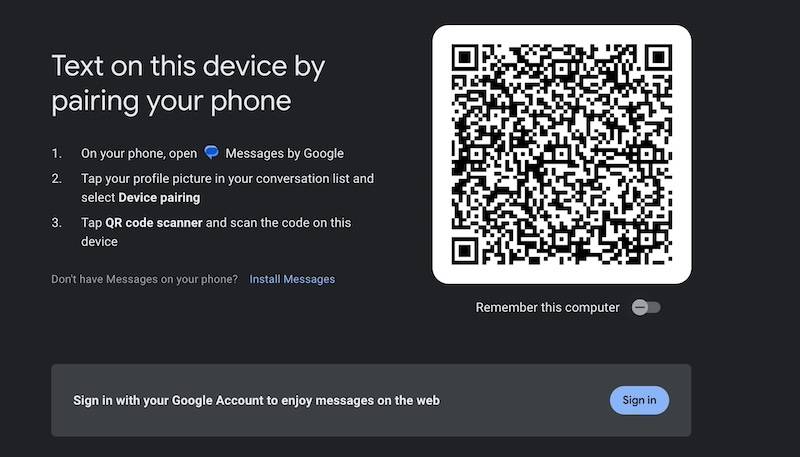
The pairing situation is also brutal.
Sure, the process is easier now that Google has made it possible to sign in with your account instead of having to scan a QR code every time, but the fact that you have to sign in more than once seems cruel.
The “Remember this computer” toggle only works for so long, and every few weeks or months or so, you have to sign back in.
In comparison, as I confirmed with my wife just now, she has never, ever had to re-sign in to iMessage on her MacBook. What a world that would be.
Beyond those core issues, the comparatively limited functionality is just a bummer. There are fewer reaction options, no predictive text, no voice-to-text, and consistent issues with contact sync and message search.
In so many words, it is bad, especially when you compare it to the original.
Google Messages not-for-Web is great
The comparison makes it so much worse
Credit: Lucas Gouveia / Android Police | Marina Demeshko / Shutterstock
The fact that Google Messages for Web is this inept wouldn’t be as much of a problem if the service it emulates wasn’t so much better in comparison.
The Google Messages app on my phone is arguably one of my favorite messaging platforms on my Pixel 10 Pro, providing a substantially better experience than its Webbed counterpart.
From the ability to customize the color of messages to the integrated Magic Cue that suggests everything from contact information to important addresses, the actual Google Messages platform has the modern feel of a real-life app that someone is actively working to improve over time.
This is what makes Google Messages for Web that much more infuriating: comparison.
Not only is the browser-based system worse than the dedicated Google Messages app, it’s also worse than competitors.
I shudder to praise Apple when it comes to this kind of technology, but iMessage on the MacBook is miles ahead of Google Messages for Web in virtually every metric.
It is easier to use, has fewer logins, and doesn’t require your phone to be tethered to your other device to work.
Some Google Messages for Web users even report having to unlock their phones before they can properly operate the platform.
I have regularly run into connectivity issues when trying to respond via the pop-up notifications on my PC, which feels like an ancient problem to have for technology in 2025.
Google Messages for Web needs to be better
What on Earth are they waiting for?
In all honesty, I have no problem logging in to a website to access my text messages if that is what the limitations of technology demand.
However, if that kind of system is what is holding Google Messages for Web back, I demand a change.
A dedicated app available to download on PCs and laptops seems like an absolute no-brainer, and it simply cannot be as hard as Google’s refusal to do so makes it seem.
Hopefully, this article will be the tipping point that Google needs to pull the trigger.











