Updated on: February 3, 2026
Fact-checked by Eric Goldstein
-
🥇 ExpressVPN
: Comes with obfuscated servers for bypassing government restrictions and includes industry-leading security features. Maintains blazing-fast speeds across all servers, has a strict no-logs policy (independently audited and confirmed), allows up to 14 simultaneous connections, and covers each first-time purchase with a 30-day guarantee.
Countries like China, Iran, and Indonesia set restrictions on what websites their citizens can view. While the best way to get around government firewalls is with a virtual private network (VPN), these restrictive countries also use sophisticated technology to detect and ban many VPNs.
That is why you need a VPN that has special features and protocols to evade these measures. Unfortunately, a lot of VPNs aren’t able to bypass government censorship — even some of the best ones out there — while a bunch of the VPNs are only able to access restricted content some of the time.
However, there are still some very good government bypassing VPNs available on the market. The ones I’ve chosen for this list are able to bypass most government restrictions with sophisticated obfuscation tools. My favorite pick is ExpressVPN; it has obfuscation on all servers, is the fastest VPN on the market, and provides high-end security features. Editor’s Note: ExpressVPN and this site are in the same ownership group.
Quick Summary of the Best VPNs for Government Bypassing


NOTE: Using a VPN to bypass government restrictions comes with some limitations. I want to make it clear that neither I nor SafetyDetectives.com support using VPNs in ways that break the law. It’s a good idea to get to know the local rules about VPNs to make sure you’re not accidentally breaking any regulations or laws.
Editor’s Note: Intego, Private Internet Access, CyberGhost and ExpressVPN are owned by Kape Technologies, our parent company
🥇1. ExpressVPN — Best VPN for Government Bypassing
Approved by our experts

ExpressVPN is the top VPN for government bypassing in 2026. It provides obfuscation on all servers and protocols, which allow you to hide your VPN traffic and enable you to bypass geo-blocks without detection in countries that censor the internet. Obfuscation is automatically enabled when you use ExpressVPN’s Automatic protocol setting.
- Bypasses most government firewalls
- Obfuscation on all servers
- Best speeds on the market
- Strong anonymity (IP Shuffle)
- Split-tunnels only apps
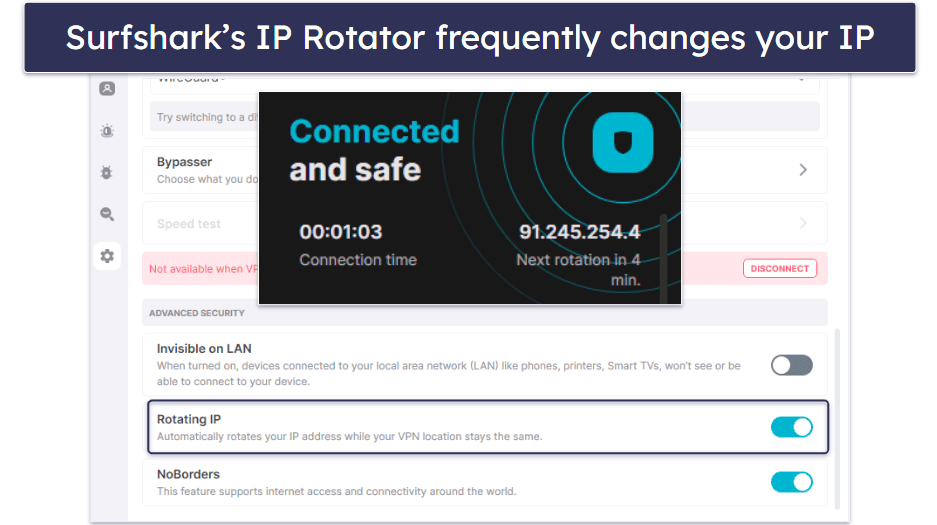
It regularly refreshes its IP addresses, making it harder for authorities to block access. Its obfuscation technology hides VPN traffic, helping to bypass deep packet inspection (DPI) that identifies and blocks VPN use. Additionally, ExpressVPN supports the OpenVPN TCP protocol over port 443 — the same port used for HTTPS traffic — making it unlikely to be blocked without disrupting normal secure internet access.
Port 443 is the standard port used for secure web browsing (HTTPS), meaning most websites rely on it for encrypted communication. Blocking this port would disrupt nearly all secure internet services, such as banking, email, and general browsing, making it unlikely for governments to block it.
It has servers in 105 countries, allowing you to find a nearby server no matter where you live. For example, if you are in China, ExpressVPN has servers in Hong Kong and Japan, and if you’re in Iran, there are servers in Egypt and Iran.
The VPN has a unique ShuffleIP feature, which maintains strong privacy and anonymity in regions with heavy internet surveillance. It assigns you a new IP address each time you visit a new website or open an app. This constant rotation of IPs makes it extremely difficult for governments or trackers to monitor your online activity or link your actions together.
ExpressVPN offers app-based split-tunneling, allowing you to choose which apps go through the VPN and which connect directly to the internet. This is especially useful for bypassing government blocks on certain apps while keeping local services that require your actual geolocation on a regular network, like banking or food delivery apps. While it doesn’t support website-based split-tunneling, it’s one of the few VPNs offering split-tunneling on Mac.
ExpressVPN accepts Bitcoin, for more anonymous payments, which is great for privacy in countries with heavy censorship.
Bottom Line:
ExpressVPN is able to bypass government restrictions in many countries without detection. It’s the fastest VPN out there, and you also get high-end security features, including extras like split-tunneling and ShuffleIP.
Read the full ExpressVPN review
🥈2. Private Internet Access — Flexible Apps With Great Speeds
Private Internet Access (PIA) is secure, fast, and good at bypassing government restrictions in censor-heavy countries thanks to its Shadowsocks obfuscation protocol that disguises your VPN traffic as regular traffic — allowing you to get around government firewalls and mask your VPN connection from your ISP. Shadowsocks is a free and open-source encryption protocol project, widely used in China and other countries to bypass internet restrictions. This obfuscation tool can be enabled with just one click in PIA’s “Proxy Preferences” menu.
- Shadowsocks proxy support
- TCP port 443 for HTTPS traffic
- Open-source, customizable apps
- Unlimited simultaneous devices
- Limited number of obfuscated servers
- Obfuscation isn’t automatic

PIA also allows you to tunnel VPN traffic through port 443 using OpenVPN. This helps bypass government censorship by disguising VPN traffic as regular HTTPS traffic.
I like how all of the apps are very customizable — they have 20+ options to change under its Settings menu, including encryption levels, and split-tunneling on a per-app or per-website basis. These options let you fine-tune your connection for better performance and stealth, which is especially useful for bypassing government censorship.
It also has MACE, the best ad blocker on the market. It’s especially useful when bypassing censorship since it blocks trackers so no one can follow your activity on different sites.
Private Internet Access accepts cryptocurrencies and even gift cards to help shield its customers’ identities.
Bottom Line:
PIA’s Shadowsocks obfuscation protocol disguises your VPN traffic as regular traffic to bypass government restrictions and browse the web undetected. It allows you to tunnel VPN traffic through port 443 using OpenVPN. Additionally, it offers highly customizable apps with extra features like split-tunneling and an ad blocker.
Read the full Private Internet Access review
Editor’s Note: Private Internet Access and this site are in the same ownership group.
🥉3. PrivateVPN — Simple VPN With Proprietary Protocol for Bypassing Censorship
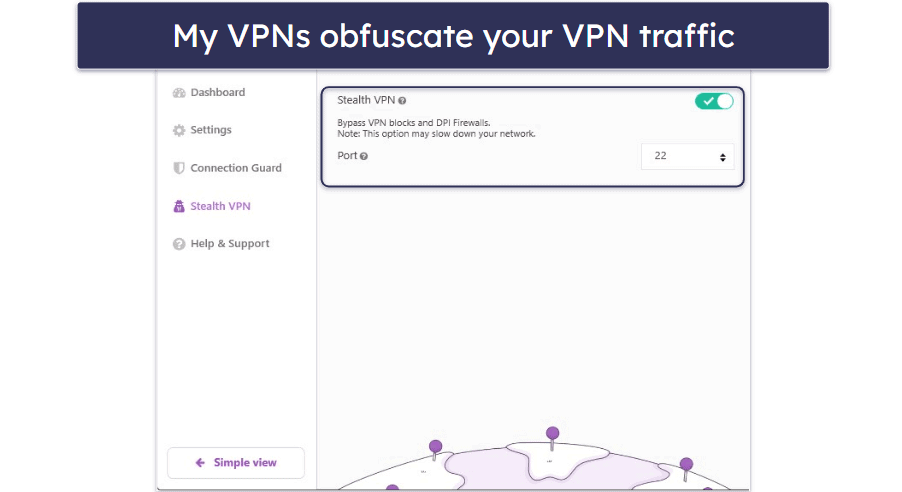
PrivateVPN uses Stealth VPN, which disguises your online traffic and makes it seem as if you’re browsing without a VPN. This allows you to bypass VPN blocks and firewalls in countries that censor the web.
- Proprietary Stealth VPN protocol
- Minimalistic, easy-to-use interface
- App Guard kill-switch feature
- No split-tunneling feature
- Missing RAM-only servers
I’m a huge fan of PrivateVPN’s very minimalistic interface that makes it easy to navigate. I was able to find and connect to a server without any issues and found and enabled Stealth VPN with ease. To activate it, switch to Advanced View, turn on Stealth VPN from the menu, then return to Simple View and pick a location to connect to.

Also, setting up an SSL VPN on PrivateVPN is a great way to get around government censorship and firewalls — it hides your internet traffic inside encrypted HTTPS sessions, making it much harder to detect or block. You’ll need to set it up manually, but PrivateVPN provides clear, step-by-step guides on its website to assist you.
PrivateVPN has servers in 63 countries around the world, which is less than ExpressVPN and Private Internet Access, but the servers are evenly dispersed in many different locations — and near restrictive countries like China, Venezuela, and Indonesia. For example, if you’re in China, there are servers in Hong Kong, Japan, and Singapore.
That being said, PrivateVPN’s apps are pretty basic and don’t come with extra features like split-tunneling, an ad blocker, or a built-in speed test — and it’s missing RAM-only servers and perfect forward secrecy
Bottom Line:
PrivateVPN bypasses government restrictions undetected using its proprietary Stealth VPN protocol. It has a very minimalistic interface and is easy to use. While it offers good security and privacy, it lacks some extra features.
Read the full PrivateVPN review
4. TunnelBear — Best VPN for New Users in Restrictive Countries


TunnelBear is one of the most beginner-friendly and fun VPNs on the market that comes with an obfuscation tool (GhostBear) that hides VPN traffic from restrictive governments. It’s very easy; you can turn it on with just 1 click in the settings menu under Connection. That said, unfortunately, GhostBear isn’t available for iOS.
- GhostBear hides VPN traffic
- Very beginner-friendly apps
- Free plan available
- No money-back guarantee
- Small server network

TunnelBear on Android supports Encrypted SNI (ESNI) and Encrypted Client Hello (ECH), which conceal the websites you visit and make it more difficult for governments to block or detect VPN use. ESNI encrypts the server name, while ECH hides the entire initial handshake, preventing network monitors from identifying your destination. These features work automatically in TunnelBear’s Android app, with browser support available in Firefox (for ESNI) and Firefox, Chrome, and Edge (for ECH).
TunnelBear has the smallest server network on this list, but the servers are strategically located evenly throughout the globe in 47 countries. No matter what restrictive country you’re in, you’ll still be able to connect to a server in a nearby country to get fast speeds.
I love its split-tunneling feature, which works on a per-app and per-website basis (similar to Private Internet Access), and it’s available across all its apps — including Mac, iOS, and Linux, which is rare for VPNs. It also offers a free ad blocker for Chrome.
Bottom Line:
TunnelBear’s stealth mode (known as GhostBear) works in restrictive countries with just 1 click. It has strong Android support for Encrypted SNI (ESNI) and split-tunneling. However, it has a smaller server network compared to other top VPNs on this list.
Read the full TunnelBear review
5. VyprVPN — Great Obfuscation With Good Security


VyprVPN bypasses government restrictions without detection. It uses its proprietary Chameleon protocol to hide your connection from your ISP or government entities. Since the Chameleon protocol disguises your internet traffic to make it look like you’re not using a VPN, countries can’t know that you’re using a VPN to bypass their firewalls.
- Chameleon obfuscation protocol
- Auto Smart IP address rotation
- Strong DNS protection (VyprDNS)
- Smaller server network
- Limited to 5 simultaneous devices
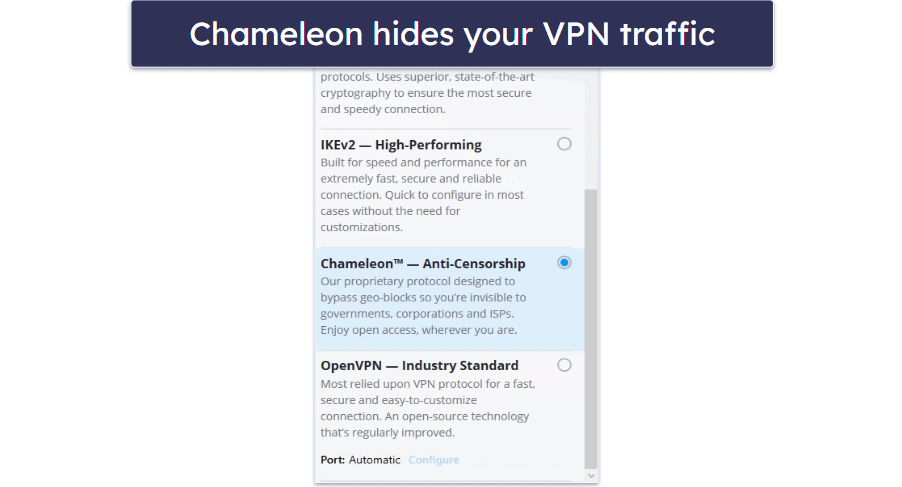
VyprVPN’s Smart IP feature helps you bypass government blocks by changing the VPN server’s IP address while you’re still connected. This makes it harder for VPN blocks to detect your connection since the IP keeps switching. It’s enabled automatically, like ExpressVPN‘s obfuscation technology.
It has a VyprDNS feature that helps bypass government censorship by defeating DNS filtering and DNS hijacking, commonly used to block or redirect websites. It securely routes DNS requests through VyprVPN’s encrypted tunnel, avoiding surveillance and manipulation by local ISPs.
Bottom Line:
VyprVPN’s Chameleon protocol allows you to bypass restrictions undetected. It also offers good speeds and security. The VyprVPN’s Smart IP feature changes the VPN server’s IP address while you’re still connected. Additionally, its VyprDNS feature helps bypass government censorship by defeating DNS filtering and DNS hijacking.
Quick Comparison Table
Editor’s Note: Intego, Private Internet Access, CyberGhost and ExpressVPN are owned by Kape Technologies, our parent company
Testing Methodology: Comparison & Ranking Criteria
I adhered to our proven testing methodology to find the best VPNs for government bypassing. I put each VPN through real-life activities and tests. I also ensured they work in restrictive countries and have the ability and features to bypass blocking technologies and challenges. Here is the criteria I followed to rank the VPNs on my list:
- I opted for a VPN capable of circumventing censorship. The VPNs I suggest are equipped with obfuscation tools, enabling them to conceal your VPN traffic and navigate through government firewalls without being detected.

- I checked for a VPN with mirror links and email support. Every VPN I recommend offers mirror download links and responsive email support, so if the main website is inaccessible, you can still get the app by contacting support for alternative links.
- I chose a VPN with strong security features. I only recommend VPNs that come with industry-standard VPN security features, including 256-bit AES encryption, a kill switch, a strict no-logs policy, and leak protection against DNS, webRTC, and IPv6 leaks. Some even use RAM-only servers, which wipe all data on reboot, and implement Perfect Forward Secrecy, which regularly changes encryption keys to keep past and future data secure in case of a breach.

- I picked a fast VPN. A VPN’s primary goal should be to secure your connection without significantly compromising speed. While all VPNs introduce some speed reduction due to encryption, the best ones minimize this effect. ExpressVPN, with its obfuscated servers, shines in this regard, consistently delivering top speeds.
- I got a VPN that provides great value. I only recommend VPNs with easy-to-use apps, extra features like split-tunneling and ad blockers, and affordable pricing.
Why You Should Use a VPN in Restrictive Countries
A VPN offers essential protections in countries that heavily restrict internet access. Here are the main benefits of using a VPN in a restrictive country:
Protecting Your Privacy
Your personal data is at risk when browsing online, especially in restrictive countries where governments can actively monitor all internet activities. A VPN encrypts your internet connection, which scrambles it and makes it unreadable. This encryption makes it extremely difficult for unauthorized individuals, including government entities and hackers, to intercept and decipher the information. This also means that all of your sensitive work-related files, financial transactions, and any communications with your family are protected, too.
Circumventing Censorship
Governments in restrictive countries often block access to the open internet. For example, China bans Facebook, Instagram, Reddit, and YouTube. A VPN masks your IP address, making it appear as if you are accessing the internet from a different location, which allows you to access blocked websites, social media platforms, and news outlets freely.
Hide Your Real IP Address
No matter where you are, a VPN can mask your real IP address. This is great for privacy as it will hide your physical location and make it difficult for any snoopers to generate a profile of you. What’s more, certain streaming services impose geographical restrictions and only show content to people in certain areas. Many top VPNs can access popular streaming services from restrictive countries by hiding your IP address. They also encrypt your traffic so all of your streaming activities are hidden from your ISP and the government.
Ensuring Freedom of Speech
Expressing your opinions freely can be risky in restrictive countries. A VPN encrypts all of your traffic and protects your communications from potential eavesdroppers and hackers, providing a safe channel for you to speak your mind without the fear of being tracked.
Protect Your Data on Public Wi-Fi
Public Wi-Fi networks come with several security and privacy vulnerabilities, such as hacking and government surveillance. A VPN creates a secure and encrypted tunnel for your data, effectively shielding you from these dangers and ensuring your online activities remain confidential and safe.
Anonymous Torrenting
In many restrictive countries, governments limit torrenting and restrict access to services like Tor, which are often used to maintain anonymity online. So if you want to torrent in a restrictive country, chances are, you’ll need a VPN to hide your IP address. This way, it’ll be very difficult for authorities and other entities to trace your online actions back to you.
Please note: Neither I nor anyone on the SafetyDetectives team encourage streaming or torrenting of copyrighted or otherwise illegal materials. You should also check local laws and regulations to ensure that your activities are not illegal in your country.
How Governments Block VPNs — And How VPNs Bypass Them
Some governments don’t just block websites — they try to block the tools that unblock them. VPNs fight back with tech that hides traffic, changes IPs, and dodges detection. Here’s how it works:
IP Blocking
Every VPN service uses specific IP addresses for its servers. Governments can identify and block these addresses. When an IP address is blocked, users cannot connect to that VPN server from within the country.
VPNs counter this by frequently updating and rotating their IP addresses. Some use residential IPs, resembling normal home internet connections, making them harder to detect. Others offer obfuscated servers designed to conceal that they are VPNs.
Port Blocking
VPNs use certain ports (virtual doorways on your device) to send and receive data. Governments can block the ports most commonly used by VPN protocols like OpenVPN or PPTP. If the port is blocked, the VPN connection won’t work.
Some VPNs use port forwarding or switch to common ports like 443 (the same port used for HTTPS websites like banks and email), which are hard for governments to block without breaking the whole internet. Others allow you to manually change the port in the settings to one that works.
Deep Packet Inspection (DPI)
Deep Packet Inspection, or DPI, is a more advanced way to block VPNs. Instead of just looking at where the traffic is going, DPI allows the government to examine how the data looks as it travels across the internet. If the traffic has a certain structure or signature that matches known VPN patterns, the system can block it — even if the IP address and port are not blocked.
To avoid detection by DPI, Advanced VPNs use stealth technology or obfuscation features. These tools disguise VPN traffic so it looks like regular internet browsing. Protocols like OpenVPN over SSL or Shadowsocks are examples of technologies that help VPN traffic blend in with normal online activity.
VPN Registration Requirements
In countries like China and Russia, VPNs must be government-approved to operate legally. These approved VPNs often have to block certain websites and may be required to log user activity. Using an unapproved VPN is technically illegal and can lead to fines, though enforcement varies.
Despite the risks, many people still use unapproved VPNs to access unrestricted content. Some download the VPN before traveling, while others use mirror sites or email support to get connected once inside the country.
Throttling or Disrupting VPN Traffic
Even if the VPN isn’t fully blocked, governments might slow it down or interfere with the connection to make it frustrating or unreliable to use.
Reliable VPNs use load balancing and multi-hop routing to maintain strong speeds. Some have auto-switching servers or offer split tunneling, which routes only certain traffic through the VPN to reduce load and keep things running smoothly.
Top Brands That Didn’t Make the Cut:
- Proton VPN. Proton VPN provides obfuscation and Alternative Routing, which should help you get around government firewalls. Despite that, the provider doesn’t work in China, and it only maybe works in other restrictive countries.
- CyberGhost VPN. CyberGhost VPN is an excellent, easy-to-use VPN with specialized torrenting and gaming servers, but it doesn’t work well in restrictive countries because it doesn’t have obfuscation or any other stealth technology.
- Hotspot Shield. Hotspot Shield is a very fast and secure VPN, but it isn’t always reliable for bypassing firewalls in restricted countries.
Frequently Asked Questions
What’s the best VPN for bypassing government restrictions?
ExpressVPN is my top pick for bypassing government restrictions in 2026. ExpressVPN uses obfuscation with its Automatic protocol setting to access geo-blocked web content by restricted countries. It’s also fast, comes with excellent security features, and offers easy-to-use apps for all devices.
Is it legal to bypass government restrictions with a VPN?
Some countries that restrict access to a free and open internet have banned the use of VPNs. If you’re using a VPN in a country that doesn’t allow VPNs, you may be breaking the law. It’s best to check your country’s local laws before using a VPN.
If usage of a VPN is allowed, you should buy a VPN before you arrive because you may be unable to access the VPN’s website from inside that country. ExpressVPN confirmed it can work in restrictive countries and provides APK downloads in case you can’t get onto the website.
How do I bypass government restrictions with a VPN?
Bypassing government restrictions with a VPN requires only 4 steps:
- Get a VPN that can bypass government firewalls before traveling to a restricted country. I recommend ExpressVPN because it works in restrictive countries, has top-notch security features, and maintains the fastest speeds in the industry.
- Download and install the VPN. Just follow the installation wizard’s instructions. The whole process should take just a couple of minutes.
- Enable obfuscation. Follow the instructions for how to turn on the VPN’s obfuscation tool. For example, ExpressVPN requires you to set your protocol to “Automatic”, while Private Internet Access requires that you enable the Shadowsocks proxy.
- Connect to a server. Open the app, scroll down the list of servers, and choose a server in a country that is closest to you that doesn’t restrict the internet. Now, you’re able to browse a free and open internet.
Can I use a free VPN to bypass government restrictions?
Maybe, but I don’t recommend that you use one. Most free VPNs don’t consistently work in restrictive countries, and they also lack essential security features, are slow, limit how much data you can use, and have glitchy apps.
It’s best to use a premium VPN like ExpressVPN for bypassing government firewalls — it’s very secure, maintains very fast speeds, and has a strict no-logs policy.